Armand Moncharmin
Armand Moncharmin is one of the two joint managers of the Paris Opera House who take over from MM. Debienne and Poligny, and whose determined skepticism toward the Opera Ghost defines the novel's comic and investigative middle section. A man of considerable private income who "did not know a note of music," Moncharmin nevertheless calls the minister of education and fine arts by his Christian name and has dabbled in society journalism. His selection of Firmin Richard as his active partner—described as "the best possible active manager"—shows a certain intelligence, even as his own musical ignorance becomes a running joke. He is a charming fellow, but his rationality and pride make him the perfect foil for the ghost's elaborate tricks, and his gradual descent from laughter to terror traces the novel's movement from skepticism to belief.
Background and Partnership
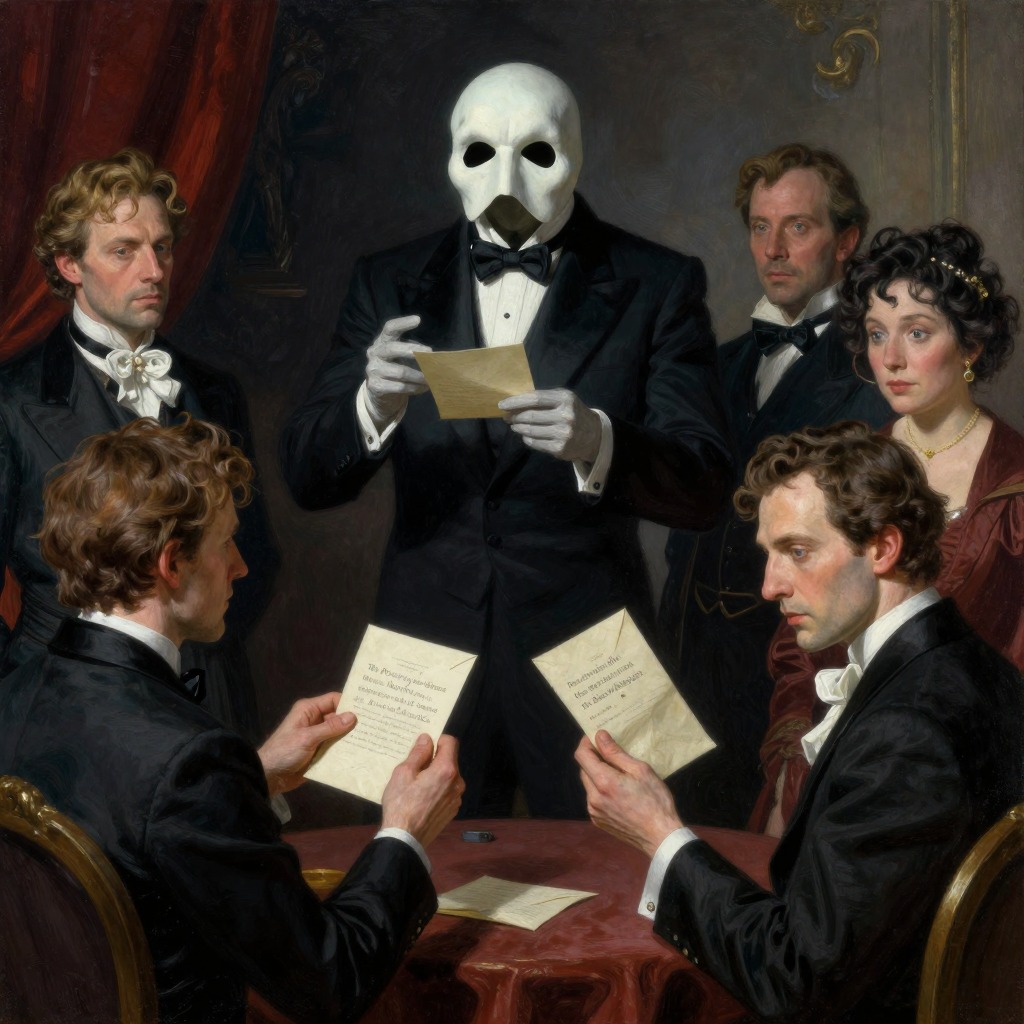
Moncharmin enters the story as the new co-manager, having chosen Firmin Richard, a distinguished composer of successful pieces who likes nearly every form of music and every sort of musician, as his active partner. The two men are introduced at the farewell supper for their predecessors, where they first encounter the ghostly figure who sits at the table without eating or drinking. When Debienne and Poligny warn them about the ghost and show them the memorandum-book with its red-ink additions—demanding a monthly allowance of twenty thousand francs and the exclusive use of Box Five—Moncharmin and Richard treat the whole affair as an elaborate practical joke. Moncharmin's Memoirs, which he writes voluminously during his co-management, become a key source for the narrator, though his account is marked by his own inability to understand what is happening to him.
The Ghost's Campaign Against the Managers
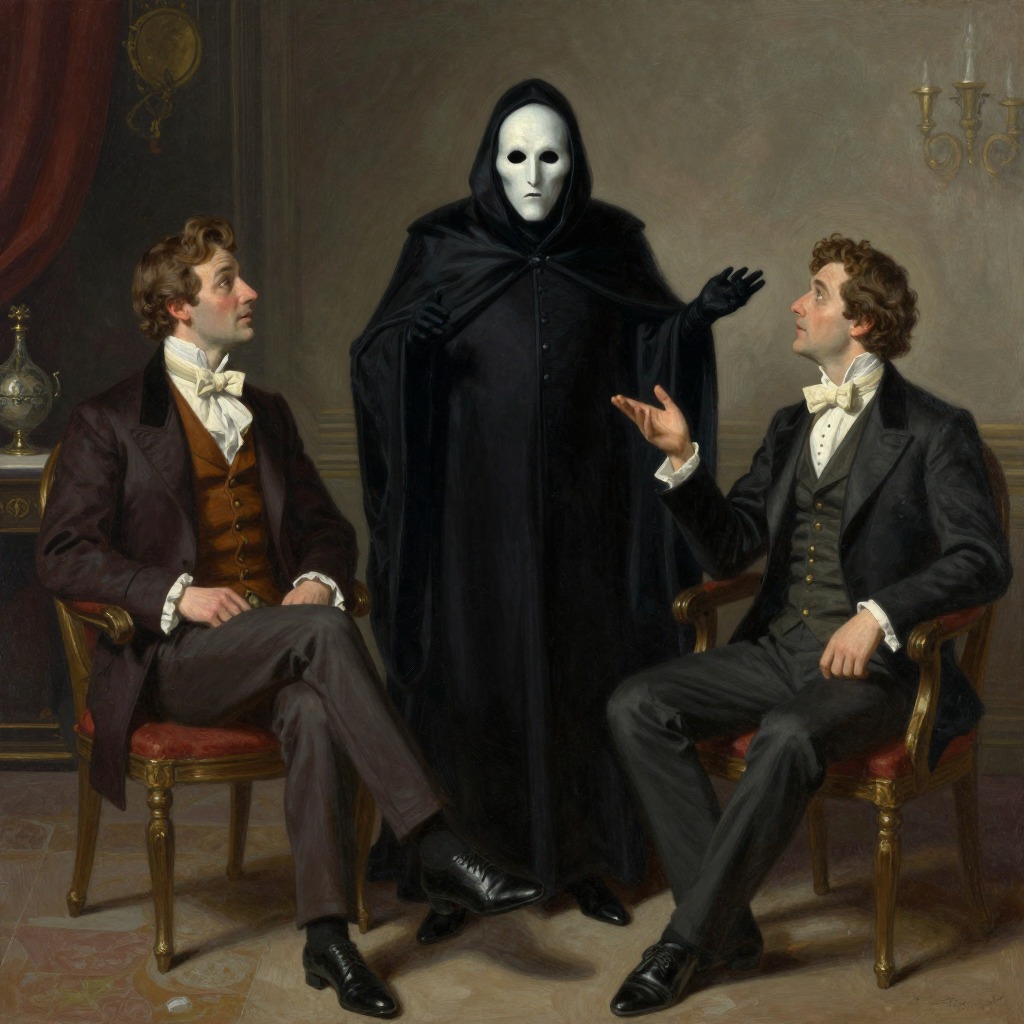
Moncharmin and Richard's first months are spent dismissing the ghost's letters as tricks by their predecessors, but the supernatural campaign quickly escalates. After they sell Box Five against the ghost's wishes, an inspector reports that occupants heard a voice saying the box was taken, and the managers summon Mme. Giry, who explains the ghost's habits—his three taps on the door, his request for a footstool, his tips of two to ten francs. Moncharmin, finding the old woman's testimony amusing, conducts the interrogation with a gravity he thinks humorous, but his laughter fades as the incidents accumulate. The ghost's ultimatum demands that Christine Daae sing Margarita, that Mme. Giry be reinstated, and that the monthly allowance be paid; when the managers refuse, Carlotta is struck by the mysterious "co-ack" during Faust, and the chandelier crashes into the stalls, killing the concierge who had replaced Mme. Giry. Moncharmin and Richard, sitting in Box Five, feel the ghost's breath around them and hear his voice in their right ears, and their terror becomes palpable.
The Magic Envelope Affair
The central test of Moncharmin's rationality comes with the ghost's demand for his monthly allowance. The managers place twenty thousand francs in an envelope and hand it to Mme. Giry, who places it in Box Five under their watch; when they open it, the real notes have been replaced by Bank of St. Farce flash notes. Moncharmin, suspecting his partner, insists on a second attempt with elaborate precautions: Richard walks backward so Moncharmin can watch his coat-tail pocket, and Mme. Giry is locked away. Yet the notes vanish again, and Moncharmin, kneeling behind Richard, finds the safety-pin still in place but the pocket empty. His cry for a safety-pin becomes a comic refrain, and his suspicion of Richard grows so intense that the two managers nearly come to blows. The theft is only explained later when the narrator discovers a trap-door in the managers' office, through which a hand could reach up and fumble at a coat pocket—the ghost's trick, made possible by his nickname "the trap-door lover."
The Night of Christine's Disappearance
On the night Christine Daae is abducted from the stage, Moncharmin and Richard are locked in their office, oblivious to the commotion. When the secretary Remy and the acting-manager Mercier try to reach them, Moncharmin opens the door only to shout for a safety-pin, and later tells Mercier that Christine's disappearance is "a good job, too." The commissary of police, M. Mifroid, eventually forces his way in, and Moncharmin, pale and speechless, is unable to explain the missing twenty thousand francs. His behavior—walking backward, refusing to be touched, demanding safety-pins—strikes the staff as madness, and the narrator notes that many subscribers believed some event even more horrible than the chandelier's fall must have affected the managers' state of mind.
Change and Resolution
Moncharmin's arc ends not with a revelation but with a quiet retreat into disbelief. After the ghost returns the forty thousand francs with a note reading "WITH O. G.'S COMPLIMENTS," Moncharmin and Richard agree to drop the matter, and Moncharmin continues to believe that Richard played a joke on him, while Richard believes the opposite. The narrator, consulting the Persian, learns that Erik restored the money because he no longer wanted it, having relinquished his marriage to Christine Daae. Moncharmin's Memoirs, which describe the ghost's behavior at length in the first part and hardly at all in the second, reflect his own failure to understand the supernatural forces he encountered. His story serves as a cautionary tale about the limits of rationalism in the face of the inexplicable, and his gradual transformation from mocking skeptic to terrified victim mirrors the novel's larger argument that the ghost, however improbable, was real.